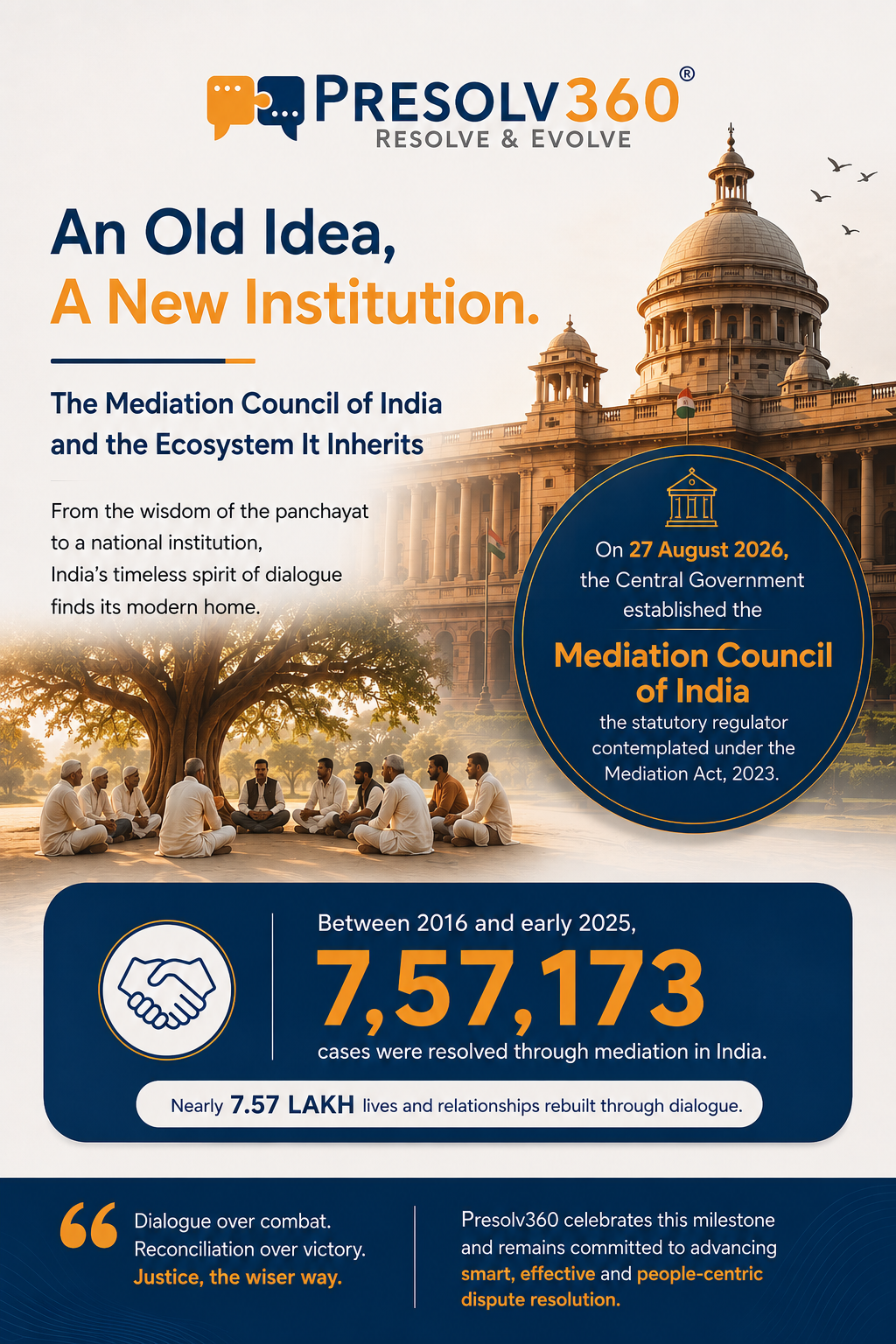
On 27 August 2026, by a Gazette notification, the Central Government established the Mediation Council of India the statutory regulator contemplated under the Mediation Act, 2023. It is a genuinely new institution. But the thing it exists to promote is one of the oldest instincts in Indian public life: settling disputes by talking them through, in a way that leaves the parties’ dignity and relationships intact. The Council does not arrive to a blank page. It arrives to a civilisational tradition and a fast-growing modern ecosystem.
Mediation is not new to India; it is one of its oldest habits
Long before India had codified procedure, it had the panchayat. The word itself carries the idea: pancha, five – a small circle of respected elders who sat with the disputing parties and worked toward a settlement the community would accept. Alongside the village panchayat, classical Smriti texts (associated with Yajnavalkya, Narada and Brihaspati) describe a tiered set of local forums the Kula (a gathering of family and kin), the Sreni (associations or guilds of traders and artisans) and the Puga (local assemblies) that resolved the disputes of their members before any question of a royal court arose. The Brihadaranyaka Upanishad is among the earliest texts to reference such bodies.
What is striking, read through a modern lens, is how closely these forums tracked what we now call mediation. As a Government of India account of panchayats and dispute resolution puts it, the elders of the puga and sreni would mediate disagreements precisely because they knew the parties, their circumstances, language, customs, usages and practices and could therefore reach the root of a quarrel/dispute quickly. The panch did not simply pronounce; he listened, drew the parties into dialogue, and steered them toward a resolution they had themselves consented to. Outcomes were held-up because they were accepted, not merely imposed upon the disputing parties.
That is the essence of mediation, and it rests on two principles the panchayat embodied instinctively: dialogue and respect for the autonomy of the parties. Mediation does not decide for people; it assists people in deciding for themselves by encouraging dialogue and arriving towards a mutual understanding. It treats a dispute not as a contest with a winner and a loser but as a relationship to be repaired. President Droupadi Murmu made exactly this point when she launched the Mediation Association of India in May 2025 recalling that the panchayat’s purpose was not only to resolve the dispute but to remove the bitterness between the parties, which she described as a pillar of social harmony. Colonial rule, she noted, imposed an adversarial system without an institutional home for this older tradition; the Mediation Act, 2023 is the attempt to give it one.
The same ethic runs through modern India’s most revered lawyer. Recounting an early case in his autobiography, The Story of My Experiments with Truth, Mahatma Gandhi wrote that he had come to see that the true function of a lawyer was “to unite parties riven asunder” and that, for much of his twenty years in practice, he devoted himself to bringing about private compromises rather than pressing cases to a ruinous finish. Dialogue over combat; reconciliation over victory. That is not a break from Indian legal tradition. It is its through-line.
The Mediation Act, 2023 codifies these instincts in contemporary form a process that is voluntary, party-driven, facilitative and confidential, in which the mediator assists but never imposes, and the settlement belongs to the parties. The panchayat’s wisdom, in other words, has been given a statute and now, a Council.
A field gets its professional home
If the tradition is ancient, the contemporary scaffolding is being built at pace and, on August 27, 2026, it got a celebratory moment. At Bharat Mandapam in New Delhi, President Murmu launched the Mediation Association of India and inaugurated the First National Mediation Conference 2025, before a gathering of the Republic’s highest legal offices: the President, the Chief Justice of India, the Law Minister, the Attorney General, the Solicitor General and a soon-to-be Chief Justice all on one stage.
A word on what the Association is, lightly but clearly: the Mediation Association of India (MAI) is a non-statutory professional body a fellowship and standard-bearer for the mediation community, there to convene practitioners, build capacity and champion the practice. It is not the statutory regulator. That role belongs to the Mediation Council of India, established separately by Gazette notification on 27 August 2026. Think of the Association as the profession’s meeting-house and the Council as its rule-maker: complementary, and easy to tell apart once you know to look.
The messaging from the bench that day set the tone for the field. The Chief Justice of India, Justice Sanjiv Khanna, urged that mediation be understood as “not a lesser form of justice but a wiser form of it,” while Justice B.R. Gavai, then Chief Justice-designate, argued that mediation should become instinctive to India’s dispute-resolution system and be taught as a skill in law schools.
The numbers: how mediation has been faring
Behind the ceremony sits measurable momentum and the figures come from the bench and the Government themselves.
Speaking at the May 2025 conference, the Chief Justice of India shared that between 2016 and early 2025, 7,57,173 cases roughly 7.57 lakh were resolved through mediation in India, evidence of the mechanism’s growing role over two decades, with rural India identified as its next frontier.
The institutional footprint has grown in parallel. In a Rajya Sabha reply reported on 13 August 2026, the Law Minister set out the scale now operating: as of March 2026, India had 452 ADR Centres and 1,394 Mediation Centres functioning nationwide, supported by a trained corps of 4,681 judicial officers, 10,124 lawyers and 753 other mediators. The human and physical capacity for mediation was laid down across the country even before the Council’s regulations formalise it. All of this against reported court pendency of roughly 5.11 crore cases across the Supreme Court, High Courts and district courts as of August, 2026 (NJDG data) the pressure that makes consensual resolution a national priority.
The wider culture of consensual resolution
Mediation sits within a broader, strikingly active culture of consensual dispute resolution anchored by the Legal Services Authorities. Through 2025, the National Legal Services Authority’s (NALSA) National Lok Adalats posted some of the largest single-day disposals on record: the first National Lok Adalat of 2025, on 8 March 2025, settled about 3.09 crore cases worth ₹18,212.23 crore, described by NALSA as its highest single-day disposal, with subsequent editions continuing to resolve cases in the crores each quarter.
From the bench: the Chief Justice’s mediation push
The Chief Justice of India, Justice Surya Kant who took office on 24 November 2025 and, as Executive Chairman of NALSA and Chairman of the Supreme Court’s Mediation and Conciliation Project Committee (MCPC), has championed the field. At the Commonwealth Peace Mediation Conference 2026 he traced the practice from India’s ancient panchayats to the Mediation Act, 2023, and distilled its spirit in a line: “Peace is not the absence of law.”
Two initiatives give that conviction concrete form.
The first is Mediation for the Nation, a 90-day pan-India special mediation drive conceptualised by NALSA with the MCPC to settle suitable pending matters from the taluka courts up to the High Courts. Its first edition ran from 1 July to 30 September 2025; a second edition, “Mediation for the Nation 2.0,” followed in 2026.
The second, and freshest, is Samadhan Samaroh 2026 the Supreme Court’s own initiative, which the Court expands as “Supreme Court Action for Mediated Adjudication and Disputes Harmonization Across Nation.” After a structured pre-settlement process that began on 21 April 2026, it culminated in a three-day Special Lok Adalat at the Supreme Court from 21 to 23 August 2026, run by sixteen benches each of two sitting judges. Per the Supreme Court’s own statement of 24 August 2026, 3,285 cases were listed over the three days; 1,664 were settled or disposed of by the Lok Adalat benches and a further 48 through mediation taking the total to 1,712 matters disposed of, with ₹240.94 crore settled.
What the new Council inherits
The Mediation Council of India inherits a remarkable dual endowment: a civilisational tradition of dialogue and party autonomy stretching from the panchayat to Gandhi, and a contemporary ecosystem already operating at scale a professional association, a nationwide network of centres, thousands of trained mediators, active judicial campaigns from the Supreme Court (Mediation for the Nation; Samadhan Samaroh), and settlement numbers in the lakhs. When the Council’s Members are appointed and its regulations notified, it will be formalising and standardising a practice India has, in one form or another, always known.
For institutions that administer mediation through technology including ODR institutions the sequence is now clear: the tradition is deep, the ecosystem is real and growing, the regulator has just been established, and national statutory recognition follows once the Council is functional. Building credibility, capacity and track record in this window is exactly what positions a provider for that moment.