The Indian legal services industry is at the precipice of a radical transformation with the introduction of Artificial Intelligence (AI) enabled tools. These tools are being utilized not only for promoting efficiency by automating and digitizing clerical work but also for reducing costs.
Another consequence of its adoption has been the creation of a new skillset among lawyers and a rising demand for lawyers who are equipped with these skills, leading to a rise in job opportunities for lawyers with the right skillset. Traditionally, Law students had gravitated towards two conventional career paths upon graduation: (1) Litigation or (2) Corporate Law, paths which were well trodden and predictable. Much like the traveler in Robert Frost’s “The Road Not Taken,” the Legal Technology (“LegalTech”) sector and Online Dispute Resolution (“ODR”) once represented the road less traveled, a path that few ventured upon.
However, the emergence of Generative AI research tools, AI-driven Contract Lifecycle Management (“CLM”) software, and ODR platforms has radically transformed this landscape. What was once an unconventional choice has now become an increasingly rewarding career pathway, expanding career opportunities and roles that were previously non-existent in the legal profession in India.
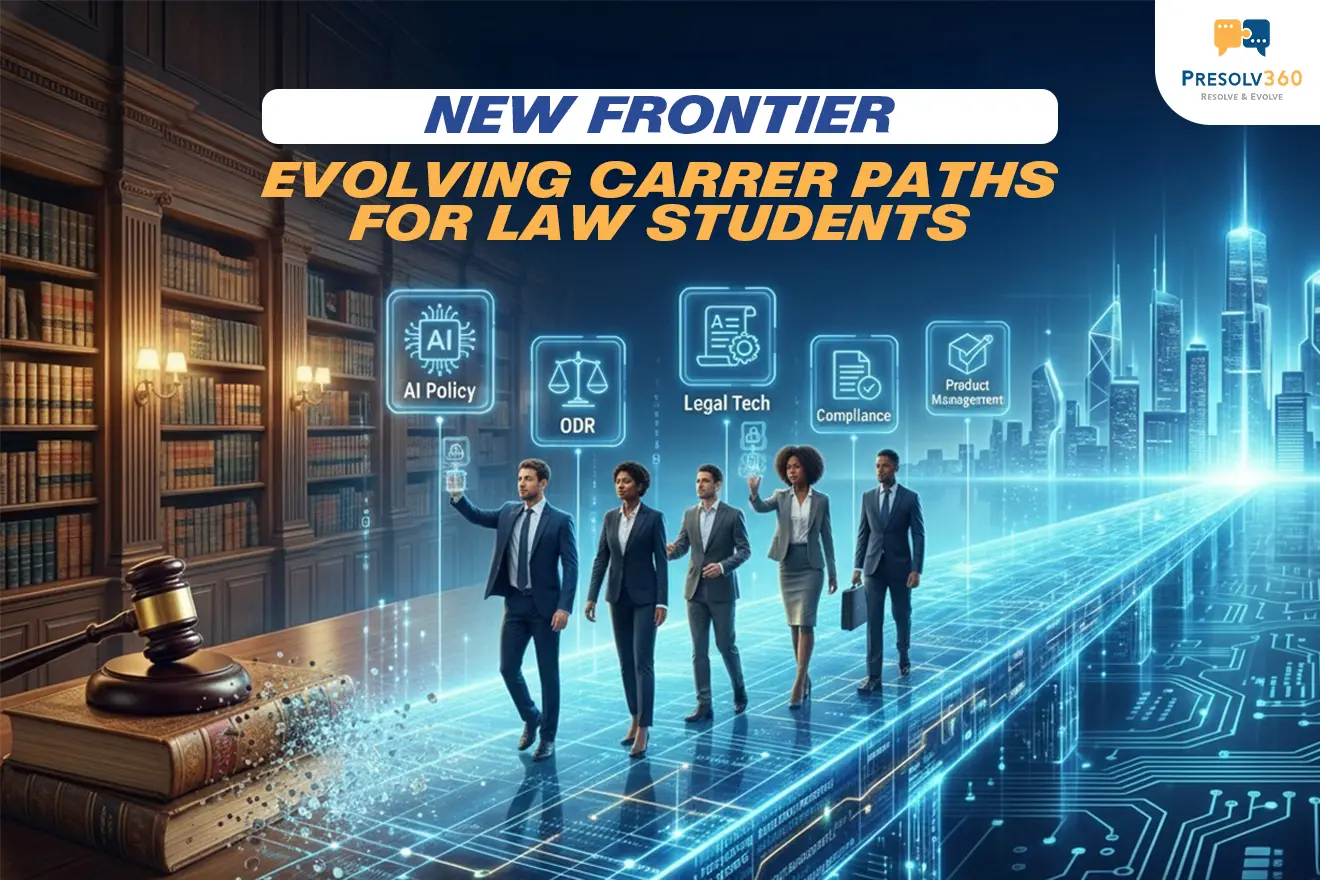
LegalTech and ODR now offer a captivating alternative career pathway to roles such as Legal Technologist, Regulatory Compliance Manager, Legal Operations Specialist, and E-discovery Specialist. These roles usually require a blend of legal acumen and proficiency in technology tools. Such opportunities are predominantly offered by LegalTech startups, law firms’ Digital & Innovation teams, ODR platforms, LegalTech consulting firms, and In-house teams.
As Artificial Intelligence continues to reshape legal services across India, building a career in LegalTech and ODR represents an increasingly promising avenue for law graduates. This article explores and studies the new job roles emerging in LegalTech and ODR, the skills required, and a detailed career roadmap to guide students in entering this rapidly growing field.
Fast-Growing Careers in LegalTech & ODR Every Law Student Should Know
New-age legal roles are emerging due to demand from businesses for higher efficiency, cost savings, and quicker dispute resolution. These new-age legal roles require a combination of legal acumen and technical proficiency.
India’s LegalTech market is expected to exceed the $1.25 billion mark by 2030 due to increasing digitization, automation, and the entry of foreign law firms. These new-generation legal positions uniquely demand a sophisticated blend of legal expertise and technical proficiency. The most prominent roles emerging in the landscape are:
- Legal Technologists – Legal Technologists assist law firms and in-house teams in adopting tools. There is a demand for general legal technologists who have expertise in a variety of areas, such as contracts, discovery, due diligence, and billing. LegalTech consulting firms usually assist such teams to evaluate and adopt tools that are best suited to their firm’s legal workflows.
- Regulatory Compliance Manager – Enterprises have to ensure that they comply with rules and regulations. A regulatory compliance manager will have to implement regulatory tools and implement compliance strategies. These managers have to perform predictive analysis and identify potential areas of non-compliance.
- Product Managers – LegalTech startups that sell tools to law firms and in-house need product managers who can manage the product throughout its lifecycle, from ideation to launch. Law students are best suited for this role due to their understanding of the problem that a tool is trying to solve.
- Contracts Manager – CLM software tools are being adopted by law firms and in-house teams. In-house teams spend 60%-80% reviewing contracts. Contract managers would be in charge of monitoring compliance, reviewing contracts, and negotiating. These managers have to improve efficiency and reduce risks for the enterprise.
- Digital Negotiators/Mediators – ODR is preferred over courts and ADR, as ODR can resolve disputes within 45-90 days while court and ADR resolve disputes in 1,445 days and 1 year respectively. Digital Negotiators would be in charge of negotiating for their clients. The main difference is that these negotiators have to be comfortable with tools like e-discovery, video conferencing, and digital contracts.
- AI Lawyers and Policy Research – Law firms are launching specialized AI law teams to identify use cases for LegalTech tools and advise on areas such as IPR and Data privacy. For example, Linklaters recently launched a 20- member AI Lawyer team. AI think tanks are emerging with research being conducted to formulate policies in line with the principle of ethics, bias, accountability and transparency.
| Role | Core Responsibility | Key Focus & Tools (Examples) |
|---|---|---|
| Legal Technologists | Optimizing legal workflows and tool adoption. | E-discovery, Billing and Due Diligence |
| Regulatory Compliance Manager | Automating compliance strategies. | Predictive Analysis and Regulatory Tools |
| Product Managers | Managing the product lifecycle (Ideation to Launch). | Solving specific legal pain points. |
| Contracts Manager | Reviewing, negotiating and monitoring agreements | CLM Software and Risk Reduction |
| Digital Negotiators | Resolving disputes online (ODR). | E-discovery and Video Conferencing |
| AI Lawyers & Policy | Advising on AI use-cases, IPR, and Ethics. | Data Privacy, IPR, AI ethics, and bias |
Skills Required to Build a Successful Career in LegalTech and ODR
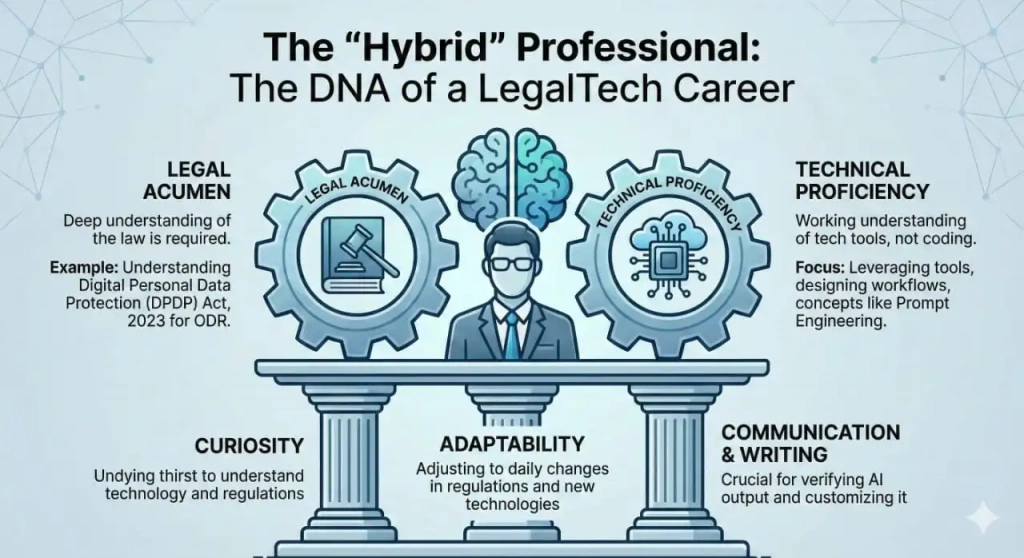
Building a career in LegalTech and ODR requires a mix of skills from curiosity to adaptability, due to rapidly evolving technologies and regulations. These skills would prepare students for a career in LegalTech and ODR.
- Curiosity – Curiosity is often an underrated skill. LegalTech and ODR require an undying thirst for understanding technology as it continuously evolves. Curiosity ensures that you are updated with the latest rules and regulations, coupled with emerging technologies such as Agentic AI, Blockchain, and Quantum Computing.
- Technical Proficiency – LegalTech and ODR professionals must have a working understanding of tech tools. This does not mean learning how to code and build foundational models. Technical proficiency refers to understanding how these tools can be leveraged to design workflows and concepts such as Retrieval-Augmented Generation, Prompt Engineering, and Deep Research.
- Legal Acumen – LegalTech and ODR professionals have to possess a deep understanding of the law. This domain expertise is context-specific and mission-critical. For instance, ODR professionals have to understand the Digital Personal Data Protection (DPDP) Act, 2023, to manage digital contracts and case files. Furthermore, a person working with AI-driven Contract Lifecycle Management (CLM) software needs to know the Indian Contract Act,1872.
- Adaptability – The needs of the legal sector are dynamic and evolve quickly. This is because regulations change, new technologies emerge and business needs shift. This might involve implementing new software solutions, adjusting workflows, and modifying the product according to new regulations. Adaptability is a key skill as the work environment changes on a day-to-day basis.
- Communication and Writing – LegalTech tools, such as AI paralegals/assistants, are able to draft contracts, research notes, and case summaries within seconds. However, law students have to verify the output of such tools and customize the AI-generated text according to the company/firm’s needs. Thus, clear communication and precise writing are crucial skills.
How Students Can Build a Career in LegalTech and ODR
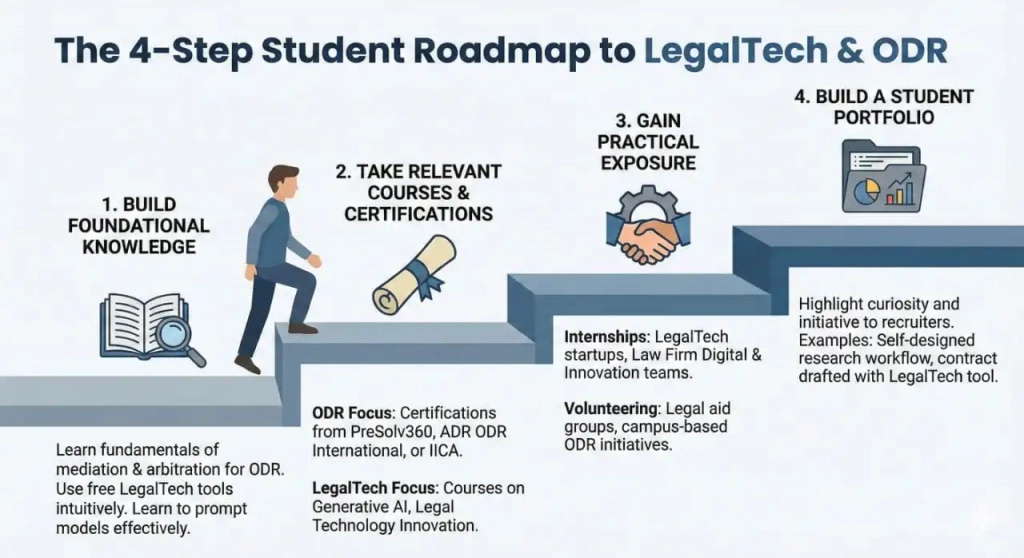
⦁ Build Foundational Knowledge
Law students can establish foundational knowledge in ODR by learning the fundamentals of mediation and arbitration. Students can learn about LegalTech tools by utilizing many of the free resources available on the internet. Through this law, students can learn how to prompt the model effectively and accurately.
⦁ Take Relevant Courses and Certifications
Students can build the skillsets required by taking relevant courses and certifications, such as:
⦁ ODR – PreSolv360’s certification course and ADR ODR International’s ODR course.
⦁ LegalTech – Courses on Generative AI for Legal Professionals
⦁ Practical Exposure
Courses and certifications are not of much use without practical exposure to ODR and LegalTech. Students can gain practical exposure in 2 ways:
⦁ Internships: Law students can intern with LegalTech startups in their product management team, Law Firms (Digital & Innovation team), and with Think Tanks alike.
⦁ Volunteering: Law students can volunteer with legal aid groups, consumer mediation cells, and immerse themselves in campus-based ODR initiatives.
Build A Student Portfolio
Recruiters prefer law students who are able to build workflows, research policy areas, and show demos of contract automation. Law students can build a portfolio, such as a 3-step research workflow they designed or a contract they drafted with the help of a LegalTech tool. This highlights curiosity and initiative, which is valued more than any technical skill.
Industry trends shaping these careers
- Courts are becoming digitized – The Indian judiciary is adopting technology to scale down its backlog of more than 4 crore cases. The shift started during COVID-19 when virtual court hearings were held. The e-courts project began its Phase I in 2009; currently in Phase III, the e-courts project has modernized the judiciary with the adoption of video conferencing facilities and e-filings. The Supreme Court has adopted tools like:
- SUPACE (Supreme Court Portal for Assistance in Court’s Efficiency): This tool automates repetitive tasks such as legal research, data extraction, and AI-generated case summarization.
- SUVAS (Supreme Court Vidhik Anuvaad Software): This tool helps translate documents and bridge language gaps.
- Law Firms are going digital –Leading Law firms are adopting LegalTech tools for legal research, contract automation and IP management. These law firms are creating a new practice called “Digital & Innovation”. This practice involves evaluating LegalTech tools and crafting GenAI strategies for these firms.
- LegalTech Startups – LegalTech startups are creating tools for different tasks such as legal research, document review, contract drafting, compliance solutions (KYC and DPDP Act, 2023) and copilots.
- ODR Platforms – ODR is being preferred over courts and ADR as it offers a timely and affordable way of resolving disputes. ODR platforms are emerging for specific niches such as family law, consumer disputes, loan disputes and MSME payment disputes.
Conclusion
Law students are no longer limited to corporate law and litigation. LegalTech and ODR are not only emerging as alternatives to traditional career paths but are the future of the legal profession. Students who invest in building hybrid skills (tech+law) will be ahead of the curve.
The future of law belongs to legal professionals such as legal technologists, digital negotiators/mediators, and contract managers. By investing in the right capabilities and experiences, students can contribute to a justice ecosystem that is faster, accessible, and citizen-centric.
Building a career in LegalTech and ODR will require students to blend legal knowledge with technical capability. If you are a student exploring these pathways, now is the time to start: take that course, volunteer with a platform, secure that internship, and begin shaping the legal future you want to be part of.
Sources: SpotDraft, Leah Molatseli, Legislate.ai, Sudhir Rao Advocate (Blog), India Today, Thomas Reuters, India.ai, legal it insider, e-committee Supreme Court of India and Yourstory Media and Dispute Resolution Online.