If you are stuck in a dispute in India today, “See you in court” can sound more like a threat, not a solution. With almost 5 crore (50 million) cases pending across Indian courts, even a simple civil or commercial dispute can feel like a decade-long tunnel with no clear exit, becoming an hindrance to ease of doing business and undermining India’s economic potential.
In the fast-evolving landscape of the Indian economy, the need for quicker and efficient dispute resolution mechanisms is no longer a distant aspiration but has become a necessity. However, as the data suggests the traditional saying “justice delayed is justice denied” has unfortunately moved from a proverb to a data-backed reality, with Hon’ble Chief Justice of India, Justice Surya Kant remarking “Justice delayed is not justice denied, it is justice destroyed.”
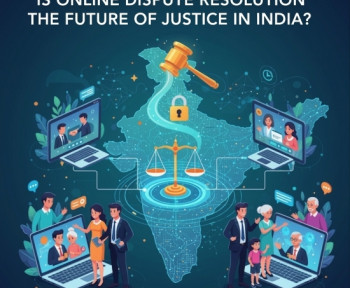
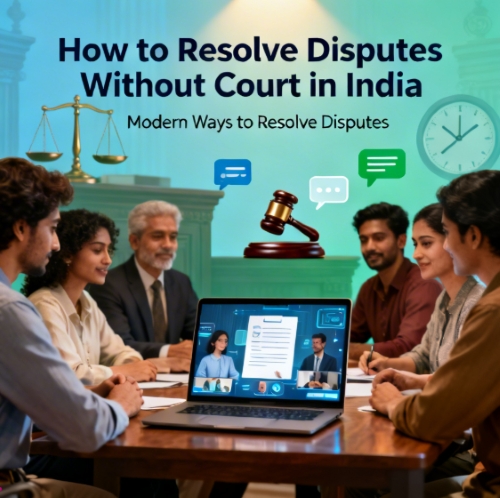
The good news is you can resolve your disputes without stepping into a courtroom and still get a legally binding and enforceable outcome. Thanks to the Governments and Judiciary’s proactive role in promoting Alternative Dispute Resolution (ADR), disputes can now be resolved in an end-to-end virtual manner by utilising Online Dispute Resolution (ODR) Institutions.
This guide explores how you can settle conflicts faster, cheaper, and with the same legal finality as a court decree.
Court vs. ODR in India (2026): Which Actually Makes Sense?
| Factor | Traditional Court Litigation | Online Dispute Resolution (ODR) |
| Time to resolution | Often 5–10+ years due to 5 crore+ case backlog | Weeks to a few months for most commercial disputes |
| Cost | High court fees, lawyer fees, travel, adjournments | Lower platform fees, fewer hearings, no travel |
| Process control | Judge‑driven, rigid procedure | Party‑driven, flexible, can choose mediator/arbitrator |
| Relationship impact | Adversarial, win‑lose | Collaborative, focuses on settlement and business continuity |
| Mode of participation | Physical presence often needed | Fully virtual: video hearings, e‑filing, e‑signatures |
| Legal enforceability | Court decree | Awards & mediated settlements enforceable as decrees |
The “Justice Gap”: Why Indian Courts are No Longer the First Step
For decades, the standard response to a breach of contract was “I’ll see you in court.” In 2026, that phrase is becoming obsolete. The sheer volume of backlogs has forced a shift in judicial philosophy.
The Union Government and the Judiciary has been making constant efforts to make Alternate Dispute Resolution a preferred / default choice, to that effect the government has undertaken various campaigns across the years aimed at building awareness among the masses, numerous legslations have been amended to incorporate ADR mechanisms into their framework. The Hon’ble Supreme Court of India in Amar Jain v. Union of India & Ors. (2025) established that inclusive digital access is an integral component of the fundamental right to life under Article 21 of the Constitution.
The 3 Pillars of ADR
Alternative Dispute Resolution (ADR) has been streamlined by the latest legislative reforms. Here is how the three pillars stand today:
1. Arbitration:
Arbitration is a private adjudicatory process where a neutral arbitrator (or tribunal) gives a binding award. The Arbitration and Conciliation (Amendment) Bill, 2024, aims to make the arbitration process efficient by minimising court intervention, strengthening institutional arbitration in India with the goal of making India a global arbitration hub. The Bill also introduces the concept of “audio-video electronic means” as a standard for filing pleadings and conducting hearings, making virtual arbitration the default for domestic commercial disputes.
2. Mediation:
Mediation is a voluntary, confidential process where a neutral mediator facilitates a settlement without imposing a decision resulting in a Win-Win situation for the parties involved. The Commercial Courts Amendment Act, 2018 made pre-litigation mediation mandatory for all commercial disputes. Moreover, the Mediation Act, 2023 gives the Mediated Settlement Agreement (MSA) the same weight as a court decree.
3. Conciliation:
Conciliation (earlier under Part III of the Arbitration and Conciliation Act, 1996) has traditionally involved a more active neutral, who can suggest solutions and help draft a settlement agreement. With the Mediation Act, 2023 explicitly including conciliation‑style processes within the broader definition of “mediation”, Indian law is moving towards using “mediation” as an umbrella term aligned with international practice.
4. ODR: The 2026 Hybrid layer
ODR is the utilisation of technology led tools (secure digital platforms) to facilitate dispute resolution through alternative dispute resolution methods like arbitration, mediation, conciliation and negotiation.
The Legal Shield: Are Out‑of‑Court & ODR Settlements Valid?
Section 89 CPC: Section 89 CPC explicitly empowers courts to formulate possible settlement terms and refer cases to arbitration, conciliation, judicial settlement including Lok Adalat, and mediation. In short, ADR is no longer “alternative” in a marginal sense; it is a system that has been advocated by the government and judiciary alike.
Enforceability of ODR Settlements and Awards
- Mediation / Conciliation Settlements
- Under Section 27 of the Mediation Act, 2023, a valid Mediated Settlement Agreement is enforceable as if it were a decree of a court, subject to limited grounds of challenge (fraud, corruption, impersonation, etc.).
- This applies equally where mediation is conducted online, as the Act expressly recognizes online mediation.
- Arbitral Awards (Including Online Arbitration)
- The Arbitration and Conciliation Act, 1996 does not distinguish between “offline” and “online” arbitration; what matters is a valid arbitration agreement and adherence to due process.An ODR‑conducted arbitral award, once passed, is enforceable like a court decree under Section 36, subject to challenge under Section 34.
Conclusion
India’s justice system today is at an inflection point. On the one hand, there is an unprecedented backlog of over 5 crore cases paralysing traditional courts. On the other, there is a powerful convergence of:
- Constitutional recognition of digital access as part of Article 21 (Amar Jain v. Union of India, 2025)
- Statutory support for mediation and pre‑litigation resolution under the Mediation Act, 2023
- The rise of institutional ODR platforms that combine technology with experienced neutrals to deliver quick, enforceable outcomes.
For individuals, startups, and enterprises, this ecosystem offers a practical way to “by‑pass the legal traffic jam” without giving up legal protection.